Ubik
★★★★☆
Ubik by Philip K. Dick (1969)
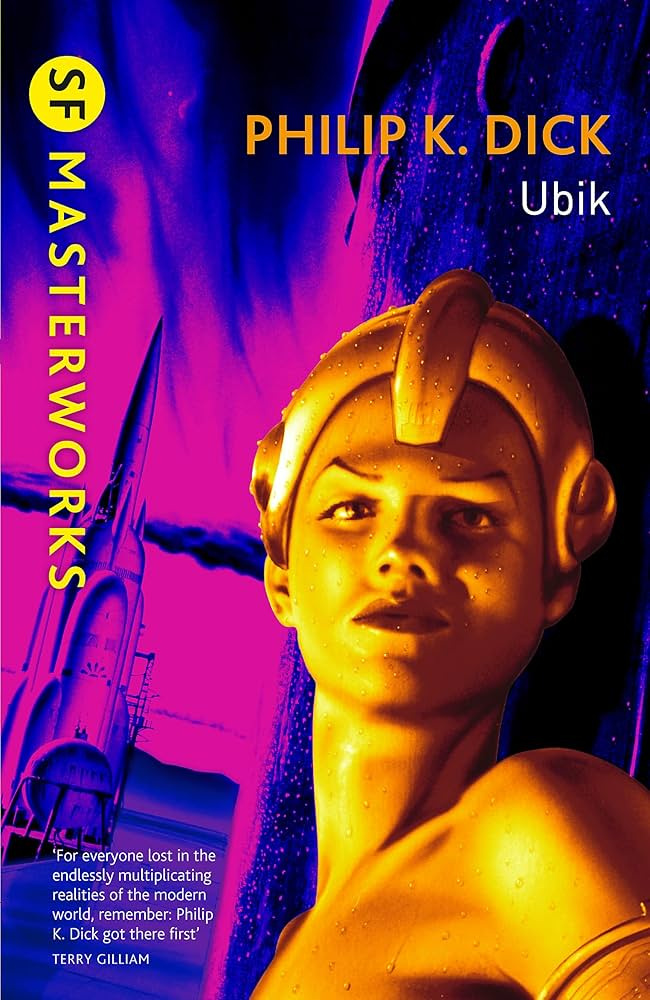
My reading backlog is endless, and I only fitted this in due to a glowing recommendation from my dear and wonderful imaginary friend. He read Project Hail Mary at my recommendation, so I figured it was mandatory to return the social nicety. What am I saying? I really liked the book. And I don’t happen to have this lovely book in my library, so I had to find an ebook.
I hate ebooks. Not as much as audiobooks, and not nearly as much as QR menus, but still.
“But Bella, I did not come to your blog to read an ebook rant. Ebooks are just as valid as real books. If not for a screen, I would never have-” I hate you too, dear reader. And don’t call me Bella.
I used to be an ebook truther. All the world at your fingertips, how cool! But consider:
You can’t flip the pages. You can’t touch it. You can’t marvel at the lovely soft cover and the colors. You can’t sit in sun by the pool with your bird and your dog and that evil cat because you can barely make out the screen. You turn your phone up to max brightness, but it’s not enough.
And you don’t own any of the books, even though they’re full price. You can’t sell them or donate them or lend them to a non-imaginary friend. You can’t thrift them or buy them on clearance for $1, because greedy publishers would rather take the loss rather than devalue.
You have to spend $200 on a Kindle that you have to charge, that breaks, that gets replaced by a new model every few years. Why should I pay you to spend more of my life glued to a screen? A device that companies have spent hundreds of millions to make as addicting as possible? People say money is the root of all evil, but I’m convinced it’s actually smartphones.
I didn’t spend long on this book, but it was a small miracle I was able to finish it at all.
Don’t even get me started on audiobooks. I, too, can “read a thousand books a year” listening to ten hour audio"books" at 2.5x speed in the background while playing Rimworld. You are not valid. Suffer as I have!!!
Sorry. Ubik.
My dear and wonderful imaginary friend said it would be better if I didn’t read the blurb. So I shall invite you to avoid it as well. Honestly, just take my ebook rant and go read the book. Preferably a physical copy.
I figured “Ubik” meant “Ubiquitous” or something by chapter two. Am I a clever girl? (actually it was short for “Ubiquity”, but close enough.)
1969 is a surprisingly long time ago. Or is it?
A side effect of dated books is that you get to see the attitudes of someone living back then. How Mr. DICK imagined the future to be: high tech, obviously. Dystopian corporations. Smart machines integrated with little AIs that demand bribes. Coins for coffee. Coins to open your own apartment door. How is that not a safety hazard?
I found it quite endearing that the broke protagonist was trying to threaten his door AI into opening. Unfortunately it didn’t work.
There’s this scene when our 1992 protagonist is transported to the past, specifically 1939:
“We have a similar problem here in the United States, both with Jews and with the [n words]. Eventually we’re going to have to do something about both.” [said a 1939 woman]
“I never actually heard the term [n word] used,” Joe said, and found himself appraising this era a little differently, all at once. I forgot about this, he realized.
The characters thought it was obviously something to be looked down upon. Does that represent the 1969 attitude of the 1939 attitude of popular American (or just Deep South) sentiment right before WWII?
I feel like 1992, 1969, 1939, and 2000 BC were all “a long time ago.” My great-grandparents might as well be dinosaurs. But this illustrates how all pasts are not equally distant.
“I have a rule,” Runciter said irritably, “about my employees sleeping with one another.” “For or against?” Zoe Wirt inquired.
It’s absurdist and wonderful. For example, I could tell you one of the central themes of this book is “Decay and Runciter”. What does that mean?
The worldbuilding: There’s people who naturally have psionic powers. There’s people (an equal amount?) that nullify psionic powers. And then there’s the majority of people, who do nothing at all.
In a sense, you’re a life form preying on the PSIs, and the PSIs are life forms that prey on the Norms. That makes you a friend of the Norm class. Balance, the full circle, predator and prey.
Naturally this has many business implications, because money makes the world go ‘round. Our guy Runciter runs a company with the anti-PSI people.
I’m left with more thoughts about the world:
- How might having powers fundamentally change the way you perceive the world? You wouldn’t think, “oh, all my friends secretly hate me” if you could literally read their thoughts. You wouldn’t stress about nailing a first impression if you can just rewind the five minutes until you land it perfectly. The crew of eleven anti-PSI people is portrayed as a mostly weird bunch. If many societal rules don’t apply to you, maybe weird is the new normal.
- How does the existence of half-life affect humanity’s view of death?
- What do you do if you’re an Evil Guy with a super powerful PSI working for you? One that could single-handedly ruin your business, maybe the world, possibly change to a timeline where you were never born? Maybe the right play is to kill her off after getting her to do a thing.
I liked Pat Conley as an archetype.
She’s hot, of course, because we (the 1969 scifi reader men) need her to breast boobily naked. Which, rest assured my 1969 goodman, she does! She’s immensely powerful and hasn’t realized her full strength. She’s inexplicably drawn to our Joe Schmoe protagonist. But the YA protagonist resemblance ends there! She’s evil, but not in a big clever way. She’s jealous, petty, traitorous, and smug. Her powers have very little impact on the plot beyond setting the group up on the moon chapter. Then she’s just a red herring.
This was a fun book. Worthy of my awful fanfiction, even.
I would like more DICK someday. Specifically, of the Philip K. variety.